
Excess Access

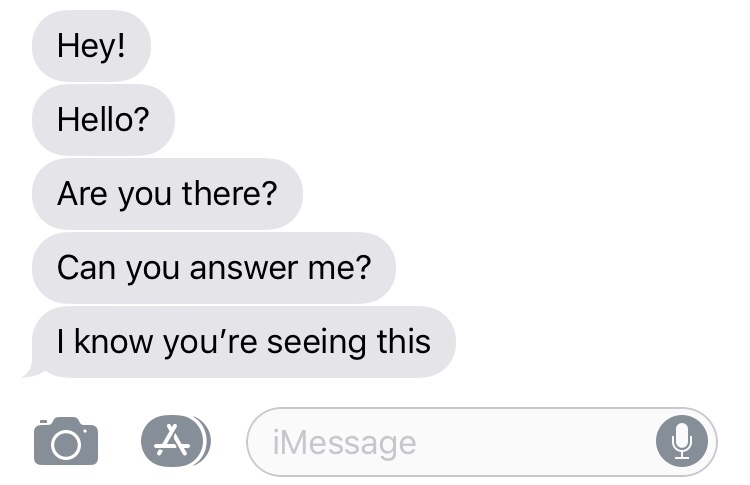
Between numerous social media accounts, cellphones, home-phones, and work phones, it’s practically impossible to be disconnected from anyone. From the time I was 9 years old when I first joined Facebook, AOL Instant Messenger, and received my first cell phone, there was almost never a moment where one could not reach me if they wanted. Over the years I had developed a dependency to these lines of communication which only got worse with every new social media account I created. Not many days went by without me checking or posting on my social media or picking up my phone every few minutes just to see if I had received any messages.

Everything changed in 2016 when I went a few months without a working phone and had to rely on my iPod and WiFi for communication. I went hours without being connected and at first it drove me insane. When I wasn’t wondering about who had reached out to me, I was worried that there could be an emergency at any moment and I wouldn’t know. Over time, I had gotten accustomed to being disconnected and realized it was incredibly freeing. Always being connected to lines of communication comes with a lot of pressure to respond in a timely fashion, and it was something I didn’t notice until I had no control over my response times.

By the time I had gotten a working phone again, I was so used to responding only when I could, that the habit remained even when the pressure to respond crept back. Without my cellphone, I had relearned the art of being present and rediscovered a life that didn’t revolve around a phone screen. I noticed just how much more time I had to myself and just how much more involved I became in every moment whether I was spending time with friends or spending time on my hobbies.

After re-launching my blog, my phone became more of a tool than a communication device which meant I was constantly using it to create content. The problem was I couldn’t open my phone to do anything productive without seeing all of my unread messages and notifications. After months of struggling to focus with a non-stop barrage of notifications forever shifting my attention, I decided that I needed to make a change. These days I live with my phone on “Do Not Disturb”, all push notifications turned off, and all social media apps (including messages) on the second page of my social app folder. This way, I can still dedicate time to the things I find important without any distractions.

We have gotten to a point where we neglect what we’re currently doing and direct our attention to whoever’s post, DM, or text we’re reading. We’ve been living a life of split focus and half presence so that others don’t feel disrespected by having been left on “seen” and we don’t feel like we’ve missed out because we missed a post, text, or call. It doesn’t seem like a big deal to provide everyone with responses in a timely fashion, or catch up on the latest posts so often, until you consider just how much time you are dedicating to other people vs how much time you are dedicating towards yourself and the present moment. Staying connected is important but not at the expense of experiencing the here and now. Everyone deserves time to shut down and disconnect from the world so they can reconnect with themselves, including you.

Be conscious of your phone use, life is too short to spend it scrolling through a gadget. Your phone does not need to govern how you spend your time and being accessible doesn’t need to mean being available. Reclaim your time and attention, if anyone is deserving of your time, it is you.

Linguistic Chameleon: A Code Switching Complex

The way we speak has a huge influence on how people perceive us. Whether we like it or not, the words we use will help others label us as educated or ignorant, one of us or one of them, from this part of town or that, and so on and so forth.

Growing up, I was surrounded by many different ways of speaking, and as a result I learned not only how to speak them all but when to switch between them. There was Spanish which I learned to speak to my family at home, the proper English I spoke in school, and the “slang” I spoke with my friends in my after school program. In school, I was encouraged to avoid speaking “slang” or New York’s personal brand of African American Vernacular “Spanglish”, but when I spoke proper English around kids at the park I quickly learned “sounding white” was not the best way to go about trying to fit in. Other times, like when my grandparents were around, I was instructed not to speak in English at all. Because I grew up being equally influenced by all three styles of speaking, all three flow very naturally to me and switching between them is as subconscious of a process as blinking is. This process of switching between styles is known as ‘code-switching’ and it is something minority and immigrant people learn to help them assimilate to their various surroundings.

When I learned about code-switching in college it was as if something inside me clicked. I knew I had been doing this all my life but I had no idea there was a name for it, or that it was a topic discussed and researched in academia. I have always felt like I have lived my life switching between vocal masks being a linguistic chameleon and it has deeply affected my sense of self.

Since the way I expressed myself was largely ruled by my environment, I began to wonder which “voice” was really mine and how I truly spoke, social pressures aside. Sometimes I questioned my own authenticity, considering that by switching the way I spoke, whether consciously or not, I was a fraud. On many occasions I’ve found myself anxiously contemplating whether I was using the right “code” at the right time or if people were judging me for the way I spoke and my constant code switching. Deep down, I knew no way of speaking was any less me than the others, just different. To say that my true self speaks onlyslang” would be largely inaccurate and to deny that proper English is what makes up most of my conscious speaking would be a farce. While Spanish is no longer as dominant in my life as it once was, it’s hard to deny its essence slips into my conversations unintentionally and unannounced. These days my surroundings do not impose or illicit a specific way of speaking so I find myself using my personal mix of the three.

While I’m still sorting through my different ways of speaking, the mannerisms I’ve attached to each, and the subconscious identity complexes I’ve acquired in my awareness of my code-switching, I am learning to see the silver lining of it all. I may not truly have a grasp of which style of speaking is my native style or if code-switching is just how I communicate, but I do know that I find comfort in my ability to assimilate to my surroundings. Being able to switch between speaking styles has greatly influenced my ability to relate to different types of people and that has enriched my life in many ways.

What is your experience with code-switching? Do you avoid it? Have you noticed it in other people? Please join in on the conversation and leave a comment letting me know what your thoughts are.

For more information on Code Switching check out these links below:

1. https://www.britannica.com/topic/code-switching

2. https://www.npr.org/sections/codeswitch/2013/04/13/177126294/five-reasons-why-people-code-switch

3. https://www.washingtonpost.com/lifestyle/style/whats-up-with-that-white-voice-the-tricky-art-of-linguistic-code-switching/2018/07/06/f083e34e-8044-11e8-bb6b-c1cb691f1402_story.html?noredirect=on&utm_term=.db2460d31122