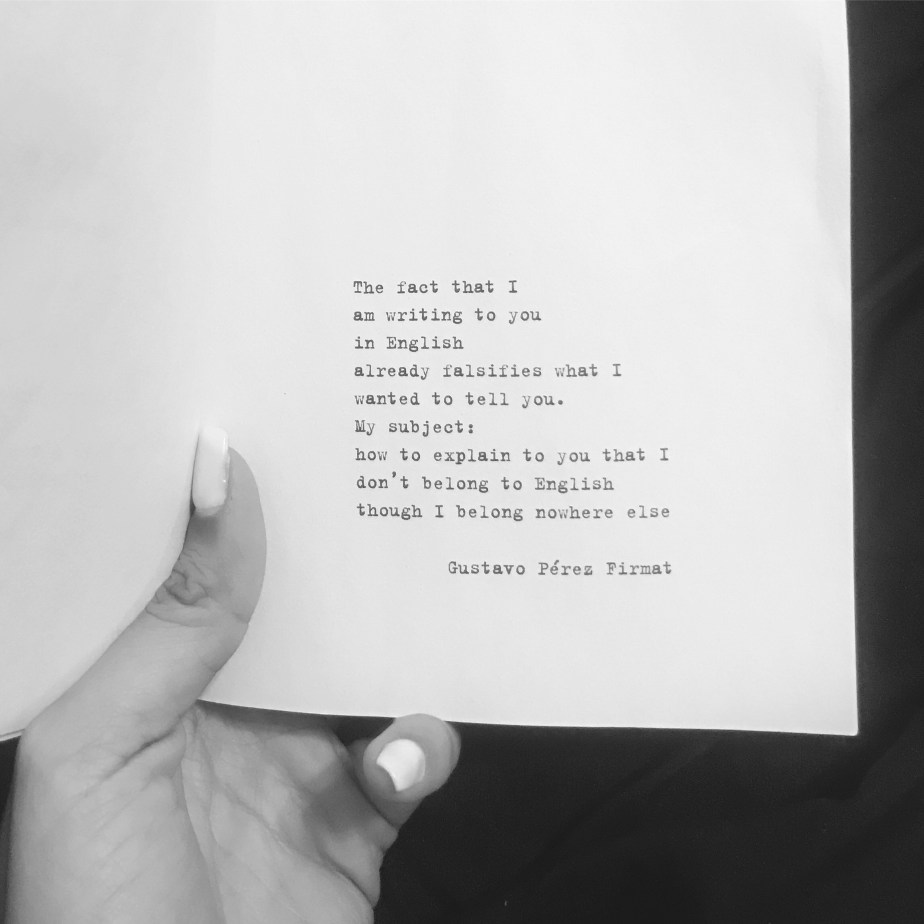
The way we speak has a huge influence on how people perceive us. Whether we like it or not, the words we use will help others label us as educated or ignorant, one of us or one of them, from this part of town or that, and so on and so forth.
Growing up, I was surrounded by many different ways of speaking, and as a result I learned not only how to speak them all but when to switch between them. There was Spanish which I learned to speak to my family at home, the proper English I spoke in school, and the “slang” I spoke with my friends in my after school program. In school, I was encouraged to avoid speaking “slang” or New York’s personal brand of African American Vernacular “Spanglish”, but when I spoke proper English around kids at the park I quickly learned “sounding white” was not the best way to go about trying to fit in. Other times, like when my grandparents were around, I was instructed not to speak in English at all. Because I grew up being equally influenced by all three styles of speaking, all three flow very naturally to me and switching between them is as subconscious of a process as blinking is. This process of switching between styles is known as ‘code-switching’ and it is something minority and immigrant people learn to help them assimilate to their various surroundings.
When I learned about code-switching in college it was as if something inside me clicked. I knew I had been doing this all my life but I had no idea there was a name for it, or that it was a topic discussed and researched in academia. I have always felt like I have lived my life switching between vocal masks being a linguistic chameleon and it has deeply affected my sense of self.
Since the way I expressed myself was largely ruled by my environment, I began to wonder which “voice” was really mine and how I truly spoke, social pressures aside. Sometimes I questioned my own authenticity, considering that by switching the way I spoke, whether consciously or not, I was a fraud. On many occasions I’ve found myself anxiously contemplating whether I was using the right “code” at the right time or if people were judging me for the way I spoke and my constant code switching. Deep down, I knew no way of speaking was any less me than the others, just different. To say that my true self speaks only “slang” would be largely inaccurate and to deny that proper English is what makes up most of my conscious speaking would be a farce. While Spanish is no longer as dominant in my life as it once was, it’s hard to deny its essence slips into my conversations unintentionally and unannounced. These days my surroundings do not impose or illicit a specific way of speaking so I find myself using my personal mix of the three.
While I’m still sorting through my different ways of speaking, the mannerisms I’ve attached to each, and the subconscious identity complexes I’ve acquired in my awareness of my code-switching, I am learning to see the silver lining of it all. I may not truly have a grasp of which style of speaking is my native style or if code-switching is just how I communicate, but I do know that I find comfort in my ability to assimilate to my surroundings. Being able to switch between speaking styles has greatly influenced my ability to relate to different types of people and that has enriched my life in many ways.
What is your experience with code-switching? Do you avoid it? Have you noticed it in other people? Please join in on the conversation and leave a comment letting me know what your thoughts are.
For more information on Code Switching check out these links below:
1. https://www.britannica.com/topic/code-switching
2. https://www.npr.org/sections/codeswitch/2013/04/13/177126294/five-reasons-why-people-code-switch
3. https://www.washingtonpost.com/lifestyle/style/whats-up-with-that-white-voice-the-tricky-art-of-linguistic-code-switching/2018/07/06/f083e34e-8044-11e8-bb6b-c1cb691f1402_story.html?noredirect=on&utm_term=.db2460d31122
 Forever Thugnacious